


VEGETABLE SEEDS
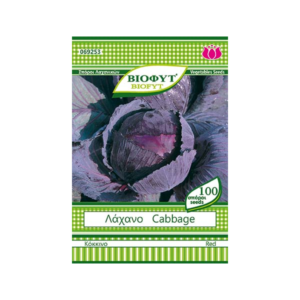
Cabbage Red
Cabbage RedCabbage is a cold season plant and the ideal temperature for its growth is 15-18 degrees Celsius. Cabbages are planted mainly in sunny positions in the fall, although semi-shaded positions are useful in early summer plantings when it is very hot. Cabbage can grow in all types of soil, except very acidic soils. It is important that the soil has good drainage to remove excess water from watering and to ensure good aeration of the roots. For early cabbages we prefer sandy, light warm soils, while for late cabbages we prefer heavier and more fertile soils with good drainage, rich in organic matter.

Brussels sprout
Brussels sproutBefore planting cabbage, the field is cleared of weeds and hard materials such as stones and wood. Cabbage benefits from residues of old crops. So if in the field, there was a previous crop without disease attacks, the residues can, instead of being destroyed, be incorporated into the soil. If it is being installed for the first time, the ground is leveled and plowed or dug to a sufficient depth (30-40cm) to improve aeration and fluff up the soil. 1-2 months before planting the crop, compost or well-digested manure is incorporated into the soil, by milling or carving.

Onion Green
Onion GreenOnions prefer light sandy soil with good drainage to grow better and form a larger bulb. Proper soil preparation is particularly important before starting cultivation. Before planting onions it is important to incorporate organic matter and soil improvement materials such as digested manure and compost into the soil. When planting onion bulbs, we can add complete organic fertilizer to strengthen the crop, especially if our field is cultivated every year and needs nutrients. 4. What season are onions planted and at what distances? The green spring onion can be planted almost all year round in our garden, while if we prefer the dry onion we plant in the March-April period. The planting of the cockle can be done both in lines and in the throws. For the linear planting of onion, shallow furrows are dug at planting distances between the planting lines of around 30 cm. The small onion bulbs are planted at distances between them of about 10 cm for the dry onion and 5-7 cm for the green onion. The planting depth of the onion in the soil should be between 0.5–1 cm, that is, just enough to cover the top pointed part of the bulb. It is worth mentioning that onion can be an excellent side crop and can be grown in our vegetable garden together with tomatoes, cucumbers, strawberries, lettuce, zucchini, beets and carrots.

Zochos (sonchus oleraceus)
Zochos (sonchus oleraceus)The Zochos has a scientific name Sonchus oleraceus. The gorse is in bloom from June to August. Its seeds ripen from July to September. Its flowers are hermaphrodite (has both male and female organs) and are pollinated by bees. The leaves of the plant closely resemble those of grasses of the same family, oblong, smooth, toothed, alternately split into pinnate lobes, and with a broad, succulent petiole that widens at the base to almost embrace the stem, and bears lateral membranous extensions, characteristic of many herbs plants, rather to increase the photosynthetic surface.

Sguash Greek
Sguash GreekSguash, one of the most popular and delicious vegetables that we plant in the spring season and harvest in the summer. The squash crop belongs to the same plant family as the cucumber, cantaloupe and watermelon with which it shares similar characteristics. Pumpkins are eaten boiled, roasted and fried and are a key ingredient in many favorite summer food recipes such as pumpkin pie, briam and stuffing. They have significant nutritional value, few calories and a high content of plant fiber, potassium and calcium vitamins. Growing pumpkin is considered quite easy. We strongly recommend it to novice growers, as it produces abundantly and quite quickly. Even if we don’t have a garden, we can plant pumpkins in a pot on the balcony. Let’s see in detail, what care is needed to grow the pumpkin in order to enjoy the most delicious pumpkins from our garden. The early planting of the pumpkin is done at the beginning of spring with ready-made plants that we have obtained from a nursery or that we prepare ourselves at the end of winter in a special nursery. If we want to grow pumpkins in late spring, we can plant the pumpkin seed directly in the ground, since at this time the temperature of the soil is suitable for the seed to germinate.

Pumpkin Large
Pumpkin LargeBefore planting pumpkin seeds, you should let them soak in warm water overnight. For cultivation, you need a container with a diameter of 10 cm to 12 cm. Two pumpkin seeds are planted per container. To do this, the pot is filled with soil one finger’s width below the rim. With the pointed end down, the seeds are pressed about two centimeters deep into the soil. The container is then placed on the windowsill and the first shoots will begin to appear after just a few days. The optimum temperature for the germination of pumpkin plants is 20°C to 25°C. To grow properly, it is important that the young plants are in an environment with constant warmth and enough light. As soon as the first true leaves appear after the vegetative leaves, and these have grown to the edge of the container, the weaker of the two seedlings is cut. Only the strongest plant is allowed to grow so that it can be placed outside in the garden later. But of course, both seedlings can remain in the container to be planted outside later.
