


Lavatera

Lavatera
Lavatera flowers are perfect for a vase for a whole week without losing their decorative appearance. As for the cultivation, many gardeners call the levatera a flower for the lazy. Indeed, culture is one of the most demanding and does not take much time from summer residents. Three-month-old Lavatera is one of the most popular varieties grown by gardeners.
She, like most flowers, prefers sunny places. These flowers do not like very wet soils, although they do not tolerate drought very well: the plant begins to drop leaves with insufficient watering. To fertilize the lava is not particularly demanding, it is enough to make fertilizer in early spring, when the bush is planted in the ground.
More Products

Euphorbia
EuphorbiaEuphorbia lactea cristata, is an easy-to-grow succulent, resulting from the grafting of two species. That is, two plants in one! Its upper part is Euphorbia lactea and its color is silver-grey, which can turn reddish if the plant is happy in its environment. Its lower part is usually Euphorbia neriifolia. Its shape resembles a coral and resulted from a normal mutation of Euphorbia lactea and is also known as Coral plant. Prefer bright spots in the growing area. With gradual acclimatization, it can also live in direct sunlight.
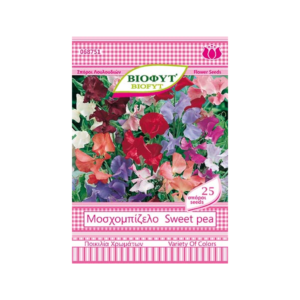
Sweet pea
Sweet peaSweet pea (Lathyrus odoratus, Fabaceae) is a genus of perennial and annual climbing plants native to the south-eastern Mediterranean, Italy, southern France and Greece. The musk pea Lathyrus odoratus is a genus of over thirty perennial and annual aromatic climbing plants, and belongs to the Fabaceae family. It is an annual climbing or erect plant with a height of 60-180 cm and a width of 40-80 cm. The leaves are grey-green, oval 5-7cm long, some have been formed into tendrils for climbing the plant. The flowers of the plant are large, fragrant, butterfly-shaped and grow many together in groups. Creates a rich and deep root system.
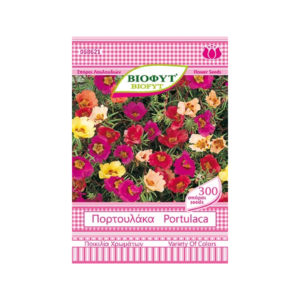
Portulaca
PortulacaPortulaca, also known as silk, is an annual ornamental plant ideal for ground cover in rock gardens, but also for planting in hanging pots on the balcony. Portulaca originates from Brazil and is characterized by creeping vegetation and fleshy oval leaves. The impressive flowering of purslane lasts from spring to autumn, with single or double flowers, monochrome, two-color and even three-color, in shades of yellow, pink, orange, red and white. Portulaca has no particular soil requirements, although it prefers fertile soils with good drainage.

Passiflora
PassifloraPassiflora, the flower of passion that impresses with its distinctive shape. Passiflora is a climbing plant that grows very quickly and is a beautiful way to cover fences and pergolas. The impressive flower of the passionflower resembles the shape of a clock, which is why in several regions of our country it is known as a clock. Passiflora is native to South America. It can reach a growth of up to ten meters and gives us its wonderful flowering in the summer. There are hundreds of species of Passiflora, most climbing, although there are also some shrubs and trees among them. A well-known species of Passiflora (Passiflora edulis) is our well-known Passion fruit, whose fruits are eaten.

Gaillardia
GaillardiaGaillardia is an impressive flower with characteristic green-grey foliage and beautiful flowers that resemble daisies in shades of red, yellow and orange. Gaillardia is characterized by abundant and prolonged flowering that lasts from early summer to mid-autumn. It comes from America and belongs to the same family as the sunflower with several varieties, some annual and others perennial and a height varying between 30-90 cm. Gaillardia is an ideal choice for planting in a flower bed, in a rock garden, as well as in a pot on the balcony. The Gaillardia plant gives a wild flower feel to our garden and is also one of the plants that attract butterflies and birds. Gaillardia needs sunny positions to give us its impressive flowering. It wants light and sandy soil that has good drainage, as young Gaillardia plants are sensitive to excess moisture. To plant it in a pot on the balcony, we prefer places with southern exposure and relatively sheltered, as it is sensitive to low temperatures and strong north winds. In any case, we put a layer of gravel at the base of the pot to drain away the water and not to close the holes of the pot due to soil compression.

Carnation Pink
Carnation PinkCarnations, one of the classic and much-loved flowers that are traditionally found in the gardens, yards and balconies of Greek homes. The carnation (carnation or dianthus) stands out for its lush vegetation with its characteristic elongated lance-shaped leaves and its rich flowering in impressive colors. There are single color carnation varieties in shades of pink, red, yellow and white, as well as bicolor carnations with wonderful color combinations. This is an extremely popular ornamental plant that, especially in previous decades, was not missing from any home. After all, the carnation has been cultivated since ancient times and was known by the name Dianthos, which means the flower of Zeus. The carnation is planted in the spring and gives us the rich flowering from April to November.
