


Portulaca

Portulaca
Portulaca, also known as silk, is an annual ornamental plant ideal for ground cover in rock gardens, but also for planting in hanging pots on the balcony. Portulaca originates from Brazil and is characterized by creeping vegetation and fleshy oval leaves. The impressive flowering of purslane lasts from spring to autumn, with single or double flowers, monochrome, two-color and even three-color, in shades of yellow, pink, orange, red and white. Portulaca has no particular soil requirements, although it prefers fertile soils with good drainage.
Portulaca has a high resistance to lack of water, as its thick leaves have the ability to store water. However, it needs regular watering especially in the summer months to enhance its abundant flowering. Adding complete fertilizer once a month during the spring and summer period ensures abundant and long-lasting flowering. It thrives in the sun and needs plenty of sunlight to give its rich and long-lasting flowering. Portulaca also tolerates a semi-shaded environment, but its flowers do not open as well. Portulaca does not tolerate the cold of winter and strong winds, so we should ensure it a protected position from wind and frost.
More Products
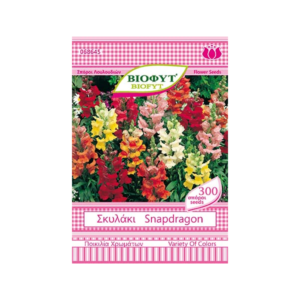
Snapdragon
SnapdragonThe Snapdragon, a favorite ornamental plant with wonderful flowers, is planted in the spring and is a characteristic plant of the Mediterranean, with rich vegetation. We will find Snapdragon in dwarf varieties from 20-40 cm, medium height from 40-60 cm and tall varieties from 60-120 cm. Although a perennial plant, it is usually planted as an annual in gardens and in pots on the balcony to give us rich flowering and impressive color combinations.

Gaillardia
GaillardiaGaillardia is an impressive flower with characteristic green-grey foliage and beautiful flowers that resemble daisies in shades of red, yellow and orange. Gaillardia is characterized by abundant and prolonged flowering that lasts from early summer to mid-autumn. It comes from America and belongs to the same family as the sunflower with several varieties, some annual and others perennial and a height varying between 30-90 cm. Gaillardia is an ideal choice for planting in a flower bed, in a rock garden, as well as in a pot on the balcony. The Gaillardia plant gives a wild flower feel to our garden and is also one of the plants that attract butterflies and birds. Gaillardia needs sunny positions to give us its impressive flowering. It wants light and sandy soil that has good drainage, as young Gaillardia plants are sensitive to excess moisture. To plant it in a pot on the balcony, we prefer places with southern exposure and relatively sheltered, as it is sensitive to low temperatures and strong north winds. In any case, we put a layer of gravel at the base of the pot to drain away the water and not to close the holes of the pot due to soil compression.

Passiflora
PassifloraPassiflora, the flower of passion that impresses with its distinctive shape. Passiflora is a climbing plant that grows very quickly and is a beautiful way to cover fences and pergolas. The impressive flower of the passionflower resembles the shape of a clock, which is why in several regions of our country it is known as a clock. Passiflora is native to South America. It can reach a growth of up to ten meters and gives us its wonderful flowering in the summer. There are hundreds of species of Passiflora, most climbing, although there are also some shrubs and trees among them. A well-known species of Passiflora (Passiflora edulis) is our well-known Passion fruit, whose fruits are eaten.

Poppy
PoppyThe poppy is a plant native to Europe, North Africa and the temperate regions of Asia, while it has acclimatized in North and South America. It got its name from the Celtic word “papa” which means “food for babies” because the Celts used to mix poppy juice in baby creams, as a medicine for childhood illnesses.

Zinnia Giant
Zinnia GiantZinnia is an annual ornamental plant that impresses with the variety of colors and shapes of its flowers. The zinnia has upright strong shoots with a length of half to one meter and large flowers that remain in bloom throughout the summer. We can find tall and short varieties of zinnia and plant them in a pot but also in a rock garden, on the lawn, and in flower beds, in various combinations with other herbaceous flowering plants.
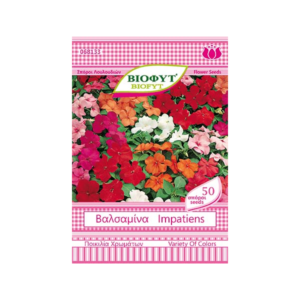
Balsamina
BalsaminaBalsamina is a decorative, small and herbaceous plant of medium growth, with intense foliage and flowers in red and pink shades.
Balsamine (Impatiens balsamine) is also known as balsamine, impatience or love. This plant is preferred for gardens and terraces as it is easy to grow and does not need much care, it has a characteristic multi-month flowering and makes the most of shady places. The planting of the balsamina should be done in shady places and not have direct contact with the sun’s rays. In combination with plenty of water, the balsamina blooms both on the branches and throughout its central trunk.
