


Basil Red

Basil Red
There are many types and varieties of basil to choose from. We come across hundreds of varieties of basil, others with smaller or larger leaves, with different colors, tastes and aromas. It is important to mention that most varieties of basil are annuals while there are also some perennials. Depending on our preferences, we can choose curly, broad-leaved, Genovese, nightshade, red (purple), saint or tree basil.
Watering basil needs special care, as many basils dry out from overwatering, showing yellowing of the leaves and root rot. We water the basil every 2-3 days, in small quantities, while on hot summer days we water it daily. It is necessary to check the soil with our finger before watering and to repeat the watering of basil only when its soil has dried.
More Products
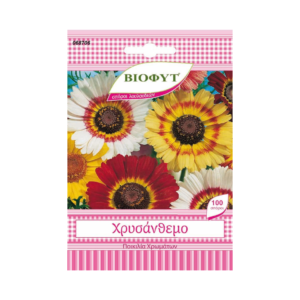
Chrysanthemum
ChrysanthemumChrysanthemum, a perennial plant with abundant flowering and beautiful daisy-like flowers in wonderful colors. Chrysanthemums are among the most popular flowers that bloom in the autumn season and belong to the same family as other favorite flowers such as dimorphotheca, silver marigold, asteraceae, marigold and gerbera. The chrysanthemum is native to Southeast Asia and China.
The seeds are planted in late spring and summer.

Poppy
PoppyThe poppy is a plant native to Europe, North Africa and the temperate regions of Asia, while it has acclimatized in North and South America. It got its name from the Celtic word “papa” which means “food for babies” because the Celts used to mix poppy juice in baby creams, as a medicine for childhood illnesses.
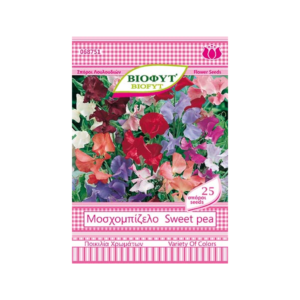
Sweet pea
Sweet peaSweet pea (Lathyrus odoratus, Fabaceae) is a genus of perennial and annual climbing plants native to the south-eastern Mediterranean, Italy, southern France and Greece. The musk pea Lathyrus odoratus is a genus of over thirty perennial and annual aromatic climbing plants, and belongs to the Fabaceae family. It is an annual climbing or erect plant with a height of 60-180 cm and a width of 40-80 cm. The leaves are grey-green, oval 5-7cm long, some have been formed into tendrils for climbing the plant. The flowers of the plant are large, fragrant, butterfly-shaped and grow many together in groups. Creates a rich and deep root system.

Primula
PrimulaThe primrose is the first flower to bloom in winter! Although a low-growing herbaceous perennial flower, the primrose is mainly planted as an annual ornamental and gives us its wonderful flowers from early January to late spring. The primula has characteristic lanceolate foliage that grows in the form of a rosette and is an ideal plant to plant in a pot on the balcony, as well as in the garden to create impressive color compositions. The name primrose comes from Latin and means first, confirming its early flowering in the heart of winter. There are, of course, some varieties of primrose that bloom in the autumn months. The leaves of the primrose resemble lettuce leaves, which is why many call it “lettuce”. There are many types of primroses with a wide variety of colors to choose from, from white, red, purple, yellow, pink, orange, blue, as well as striking bi-color varieties that have been created in recent years.
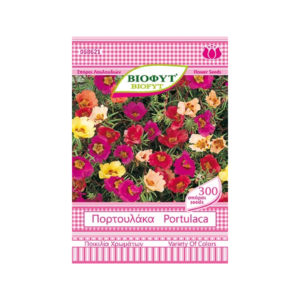
Portulaca
PortulacaPortulaca, also known as silk, is an annual ornamental plant ideal for ground cover in rock gardens, but also for planting in hanging pots on the balcony. Portulaca originates from Brazil and is characterized by creeping vegetation and fleshy oval leaves. The impressive flowering of purslane lasts from spring to autumn, with single or double flowers, monochrome, two-color and even three-color, in shades of yellow, pink, orange, red and white. Portulaca has no particular soil requirements, although it prefers fertile soils with good drainage.

Phlox
PhloxPhlox (with more common species Phlox drummondii and Phlox paniculata, Polemoniaceae) is a popular herbaceous ornamental that grows mainly as an annual, but in areas with mild winters it can be planted as a perennial. It is a genus of at least forty species and many hybrids have been created. Phlox belongs to the Polemoniaceae family, is native to North America and has historically been a fixture in gardens and parks around the world. The phlox Phlox drummondii is a genus of many species, annual and perennial, and belongs to the Polemoniaceae family. It comes from North America and is a plant with great participation in landscape architecture.
