


Amaranth Red

Amaranth Red
It is a very tall and beautiful plant, which literally any plot is able to decorate. The culture itself is one year old, but it can be grown by self-employment.
In height, amaranth in nutritious soil with sufficient moisture can reach two and sometimes three meters. The unusual characteristics of Amaranth are associated with the fleshy stem and large leaf blades, which in addition to the usual green color can be painted in violet and bright red shades.
This plant is also useful and beautiful, it has been known to man for more than eight thousand years and was withdrawn from the diet of the inhabitants of Russia by order of Peter I, who, imitating the West, actively introduced the cultivation of wheat.
Currently, there is a rapid increase in amaranth cultivation. Due to its utility and versatility, the area under it is increasing every year.
More Products

Amaranth Trichomo
Amaranth TrichomoIn the world flora, common amaranth is represented by more than sixty species. There are annual and perennial crops that are resistant to even the most severe frosts and resistant to any pest. Growing a plant is simple and not troublesome. With such a wide variety of varieties and types, you can get confused and buy feed or vegetables instead of ornamentals. Which varieties are the most popular and in demand and in what quality.

Gaillardia
GaillardiaGaillardia is an impressive flower with characteristic green-grey foliage and beautiful flowers that resemble daisies in shades of red, yellow and orange. Gaillardia is characterized by abundant and prolonged flowering that lasts from early summer to mid-autumn. It comes from America and belongs to the same family as the sunflower with several varieties, some annual and others perennial and a height varying between 30-90 cm. Gaillardia is an ideal choice for planting in a flower bed, in a rock garden, as well as in a pot on the balcony. The Gaillardia plant gives a wild flower feel to our garden and is also one of the plants that attract butterflies and birds. Gaillardia needs sunny positions to give us its impressive flowering. It wants light and sandy soil that has good drainage, as young Gaillardia plants are sensitive to excess moisture. To plant it in a pot on the balcony, we prefer places with southern exposure and relatively sheltered, as it is sensitive to low temperatures and strong north winds. In any case, we put a layer of gravel at the base of the pot to drain away the water and not to close the holes of the pot due to soil compression.

Passiflora
PassifloraPassiflora, the flower of passion that impresses with its distinctive shape. Passiflora is a climbing plant that grows very quickly and is a beautiful way to cover fences and pergolas. The impressive flower of the passionflower resembles the shape of a clock, which is why in several regions of our country it is known as a clock. Passiflora is native to South America. It can reach a growth of up to ten meters and gives us its wonderful flowering in the summer. There are hundreds of species of Passiflora, most climbing, although there are also some shrubs and trees among them. A well-known species of Passiflora (Passiflora edulis) is our well-known Passion fruit, whose fruits are eaten.
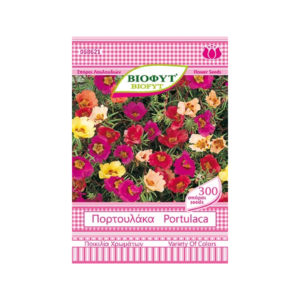
Portulaca
PortulacaPortulaca, also known as silk, is an annual ornamental plant ideal for ground cover in rock gardens, but also for planting in hanging pots on the balcony. Portulaca originates from Brazil and is characterized by creeping vegetation and fleshy oval leaves. The impressive flowering of purslane lasts from spring to autumn, with single or double flowers, monochrome, two-color and even three-color, in shades of yellow, pink, orange, red and white. Portulaca has no particular soil requirements, although it prefers fertile soils with good drainage.

Sunflower Bicolor
Sunflower BicolorThe sunflower, the well-known sunflowers, is a favorite summer plant to decorate our garden or balcony to give us its impressive flowering. The name of the sunflower comes from the fact that its head constantly turns towards the sun’s rays during the day and turns again, in the morning hours, towards the east. The dwarf varieties of sunflower, which reach up to 40-50 cm in height, are suitable for pots, while for the garden we prefer the taller varieties that exceed one meter and are also edible. The characteristic color of sunflower flowers is yellow but now new sunflower varieties have been created in shades from pale yellow to red and brown.

Cactus
CactusCacti need full sun exposure, with very few exceptions, and a long warm season exceeding 6 months to grow. The intense activity of the cacti takes place during the spring and summer period, during which, in addition to growth, they also give their unique flowering. As for winter, a period of dormancy, cacti seek temperatures of 5-15°C, although some of them can withstand sub-zero temperatures for a while. Cacti need coarse, sandy, draining soil to grow. An ordinary general-purpose potting soil is not suitable for cacti, as it retains a lot of moisture. That is why we use specialized potting soil for cacti enriched with nutrients. Cacti definitely need fertilization, especially during the spring and summer when they do most of their growth. Specialized fertilizers for cacti, water-soluble with enough trace elements, are needed to improve growth and give their wonderful flowering. We add water-soluble fertilizer to the cacti twice a month for the spring and summer periods.
