


Callistephus

Callistephus
More Products


Snapdragon Giant
Snapdragon GiantThe Snapdragon, a favorite ornamental plant with wonderful flowers, is planted in the spring and is a characteristic plant of the Mediterranean, with rich vegetation. We will find Snapdragon in dwarf varieties from 20-40 cm, medium height from 40-60 cm and tall varieties from 60-120 cm. Although a perennial plant, it is usually planted as an annual in gardens and in pots on the balcony to give us rich flowering and impressive color combinations. Snapdragon thrive in full sun, although they can adapt and thrive even in shady areas.


Gaillardia
GaillardiaGaillardia is an impressive flower with characteristic green-grey foliage and beautiful flowers that resemble daisies in shades of red, yellow and orange. Gaillardia is characterized by abundant and prolonged flowering that lasts from early summer to mid-autumn. It comes from America and belongs to the same family as the sunflower with several varieties, some annual and others perennial and a height varying between 30-90 cm. Gaillardia is an ideal choice for planting in a flower bed, in a rock garden, as well as in a pot on the balcony. The Gaillardia plant gives a wild flower feel to our garden and is also one of the plants that attract butterflies and birds. Gaillardia needs sunny positions to give us its impressive flowering. It wants light and sandy soil that has good drainage, as young Gaillardia plants are sensitive to excess moisture. To plant it in a pot on the balcony, we prefer places with southern exposure and relatively sheltered, as it is sensitive to low temperatures and strong north winds. In any case, we put a layer of gravel at the base of the pot to drain away the water and not to close the holes of the pot due to soil compression.
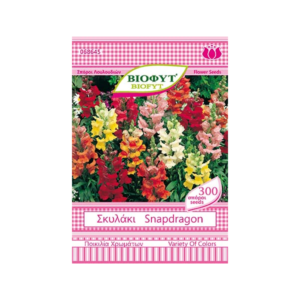
Snapdragon
SnapdragonThe Snapdragon, a favorite ornamental plant with wonderful flowers, is planted in the spring and is a characteristic plant of the Mediterranean, with rich vegetation. We will find Snapdragon in dwarf varieties from 20-40 cm, medium height from 40-60 cm and tall varieties from 60-120 cm. Although a perennial plant, it is usually planted as an annual in gardens and in pots on the balcony to give us rich flowering and impressive color combinations.

Euphorbia
EuphorbiaEuphorbia lactea cristata, is an easy-to-grow succulent, resulting from the grafting of two species. That is, two plants in one! Its upper part is Euphorbia lactea and its color is silver-grey, which can turn reddish if the plant is happy in its environment. Its lower part is usually Euphorbia neriifolia. Its shape resembles a coral and resulted from a normal mutation of Euphorbia lactea and is also known as Coral plant. Prefer bright spots in the growing area. With gradual acclimatization, it can also live in direct sunlight.
