


Stevia

Stevia
Stevia is a perennial plant, also known as melophyllo or sweet leaf of Paraguay. Stevia contains a substance, steviol, which has a high sweetening power, which is why it is used as a sweetener instead of sugar. We can grow stevia in a pot or in the garden and harvest its leaves to sweeten our coffee, tea or to use in various homemade sweets.
Stevia in the early stages of growth will need small and frequent waterings to root better when transplanted. Then, frequent watering is required during the summer season. Regarding the fertilization of stevia, the incorporation of a small amount of organic fertilizer once a month during the spring period is imperative. Stevia can be harvested three months after transplanting into the garden or pot, the period just before flowering. Stevia needs severe pruning in early autumn to produce new growth again the following year. Stevia is propagated mainly by cuttings, but also by seed.
More Products

Oregano
OreganoOregano does not have special soil requirements, as long as it has very good drainage to remove water. It is cultivated, even in very poor, dry and stony soils. Oregano gives us lush vegetation and flowering when planted in sunny positions. It is resistant to heat during the summer and relatively resistant to frost in winter. To plant oregano in a pot, place it on a west or south facing balcony. For planting in a rock garden, oregano pairs well with marjoram and thyme, which have similar care requirements.

Sage
SageSage is quite a hardy plant and grows in a variety of soils, even dry, barren and stony soils. Sage grows best in sandy, calcareous soils with very good drainage that warm up in early spring. Sage is resistant to both low and high temperatures, meaning we can plant it in hot and cold areas. Prefers places with sun both in the garden and on the balcony.
When planted in the shade, it shows stunted growth and can show rot in the shoots and the root. Incorporating organic matter in the form of digested manure and compost when planting sage is beneficial for its growth.

Marconi beans
Marconi beansThere are many popular native and traditional bean cultivars, both low and climbing, to choose from. Most growers prefer fresh bean varieties that do not have fiber, as they are more pleasant to eat. We should note that the dry bean varieties have a harder shell and more fiber. Well-known varieties of fresh beans are chauli, terli, broad bean (black-eyed), broad bean (snake bean), mullets (beads), canary beans (yellow beans), bulgara (early mullet), zargana, climbing mullet, while in some regions we will meet other interesting local varieties. An excellent traditional variety of dry beans are the giants of Prespa. It is worth noting that the climbing bean varieties are much more productive than the low varieties, while at the same time they have a longer production period, although they take longer to enter production than the low ones.
Bean cultivation needs fertile soil, rich in organic matter and with good drainage to have good growth and fruiting. When preparing the soil for cultivation, we first plow the field to make the soil sufficiently loose, as it is necessary for the formation of a rich and strong root system of the bean. Then, before planting the bean, we incorporate enough compost, digested manure and organic manure to enrich the soil with organic matter and nutrients.
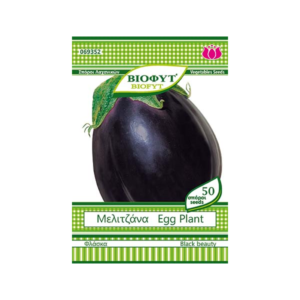
Eggplant Flask
Eggplant FlaskEggplant, the summer’s favorite vegetable! Eggplant is one of the main ingredients of the Mediterranean cuisine that we enjoy in unique summer recipes, from the world-famous moussaka, to the wonderful shoes and the Asia Minor imam baildi. Eggplant is a vegetable with high nutritional value that contains many antioxidants and vitamins. It is eaten mainly grilled, fried but also stewed. We avoid eating eggplant raw, because of its bitter taste, as well as the solanine, a toxic substance it contains when harvested prematurely.
The eggplant crop grows to a height of about 80-90 centimeters and usually does not need subtiling. Eggplant leaves have a smooth upper surface and are smooth while the underside is relatively fluffy. It is planted in the spring and forms characteristic purple flowers that give us the fruits in the summer.
There are many known varieties and hybrids of eggplant to grow. It is important to choose eggplant varieties from our own seed that we keep, so that we know the special characteristics of each variety and how it adapts to the conditions of our region. Among the traditional and local eggplant varieties, we distinguish the Lagada eggplant variety with its long, narrow purple fruits, the purple flask eggplant used in stuffed foods, as well as the teardrop eggplant with its characteristic shape. The two-colored Tsakonian eggplant with its white and purple stripes is also unique and particularly popular and does not taste bitter. Also, the Santorini eggplant is a very distinctive variety with impressive white round fruits and a delicious sweet taste that is not bitter.
Eggplant cultivation grows best in areas with a warm climate. It is worth mentioning that the eggplant needs more heat than the tomato crop and the pepper crop, as well as being much more sensitive to low temperatures and frost. Eggplant planting takes place from April onwards, when the temperature has risen noticeably. Eggplant grows in loose, fertile soils that have good drainage to remove excess water. When preparing the soil for cultivation and before planting the eggplant, we plow the garden and incorporate enough organic matter into the planting pits in the form of compost and digested manure, as well as complete organic fertilizer.

Celery aromatic
Celery aromaticCelery varieties, depending on the part of the plant for which they are grown, are divided into two main categories: a) leafy ones that have rich foliage vegetation and b) rhizomes that have less growth of the above-ground part of the plant and more root growth. The best-known varieties are the traditional variety of celery, the variety of celery and the variety of celeriac, which have the following characteristics: Common variety of celery: Traditional local leafy variety of celery with thin stems and leaves that have a strong aroma and taste Celery variety: Classic leafy variety of celery with thick crisp stems that reach a height of up to one meter and large leaves but not as strongly scented as the common variety. Celery root variety: Characteristic variety of root celery eaten for its large round root, fresh or cooked in salads and soups.

Borloto beans
Borloto beansThere are many popular native and traditional bean cultivars, both low and climbing, to choose from. Most growers prefer fresh bean varieties that do not have fiber, as they are more pleasant to eat. We should note that the dry bean varieties have a harder shell and more fiber. Well-known varieties of fresh beans are chauli, terli, broad bean (black-eyed), broad bean (snake bean), mullets (beads), canary beans (yellow beans), bulgara (early mullet), zargana, climbing mullet, while in some regions we will meet other interesting local varieties. An excellent traditional variety of dry beans are the giants of Prespa. It is worth noting that the climbing bean varieties are much more productive than the low varieties, while at the same time they have a longer production period, although they take longer to enter production than the low ones.
Bean cultivation needs fertile soil, rich in organic matter and with good drainage to have good growth and fruiting. When preparing the soil for cultivation, we first plow the field to make the soil sufficiently loose, as it is necessary for the formation of a rich and strong root system of the bean. Then, before planting the bean, we incorporate enough compost, digested manure and organic manure to enrich the soil with organic matter and nutrients.
