


Statice

Statice
Statice is a plant with many varieties. It has large broad leaves and many flowers, blue, white, pink, purple or greenish-yellow, on stems.
If we cut them, they keep well and need heat.
Propagated by seed in early spring.
More Products

Cactus
CactusCacti need full sun exposure, with very few exceptions, and a long warm season exceeding 6 months to grow. The intense activity of the cacti takes place during the spring and summer period, during which, in addition to growth, they also give their unique flowering. As for winter, a period of dormancy, cacti seek temperatures of 5-15°C, although some of them can withstand sub-zero temperatures for a while. Cacti need coarse, sandy, draining soil to grow. An ordinary general-purpose potting soil is not suitable for cacti, as it retains a lot of moisture. That is why we use specialized potting soil for cacti enriched with nutrients. Cacti definitely need fertilization, especially during the spring and summer when they do most of their growth. Specialized fertilizers for cacti, water-soluble with enough trace elements, are needed to improve growth and give their wonderful flowering. We add water-soluble fertilizer to the cacti twice a month for the spring and summer periods.

Euphorbia
EuphorbiaEuphorbia lactea cristata, is an easy-to-grow succulent, resulting from the grafting of two species. That is, two plants in one! Its upper part is Euphorbia lactea and its color is silver-grey, which can turn reddish if the plant is happy in its environment. Its lower part is usually Euphorbia neriifolia. Its shape resembles a coral and resulted from a normal mutation of Euphorbia lactea and is also known as Coral plant. Prefer bright spots in the growing area. With gradual acclimatization, it can also live in direct sunlight.
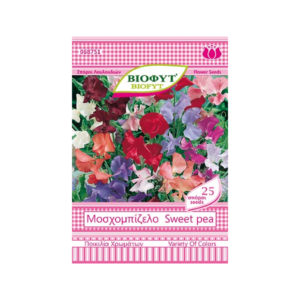
Sweet pea
Sweet peaSweet pea (Lathyrus odoratus, Fabaceae) is a genus of perennial and annual climbing plants native to the south-eastern Mediterranean, Italy, southern France and Greece. The musk pea Lathyrus odoratus is a genus of over thirty perennial and annual aromatic climbing plants, and belongs to the Fabaceae family. It is an annual climbing or erect plant with a height of 60-180 cm and a width of 40-80 cm. The leaves are grey-green, oval 5-7cm long, some have been formed into tendrils for climbing the plant. The flowers of the plant are large, fragrant, butterfly-shaped and grow many together in groups. Creates a rich and deep root system.

Nice of the Day Flower
Nice of the Day FlowerThis plant grows in the spring with beautiful clean green foliage producing beautiful colorful flowers with bright “neon” colors that close at night. Very easy to grow, the beauty of the day is the star in a small garden full of “wild flowers”. The beautiful of the day does not need particularly fertile soils, but sandy and well-drained. It is resistant to the marine climate.
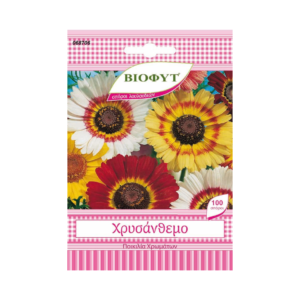
Chrysanthemum
ChrysanthemumChrysanthemum, a perennial plant with abundant flowering and beautiful daisy-like flowers in wonderful colors. Chrysanthemums are among the most popular flowers that bloom in the autumn season and belong to the same family as other favorite flowers such as dimorphotheca, silver marigold, asteraceae, marigold and gerbera. The chrysanthemum is native to Southeast Asia and China.
The seeds are planted in late spring and summer.

Passiflora
PassifloraPassiflora, the flower of passion that impresses with its distinctive shape. Passiflora is a climbing plant that grows very quickly and is a beautiful way to cover fences and pergolas. The impressive flower of the passionflower resembles the shape of a clock, which is why in several regions of our country it is known as a clock. Passiflora is native to South America. It can reach a growth of up to ten meters and gives us its wonderful flowering in the summer. There are hundreds of species of Passiflora, most climbing, although there are also some shrubs and trees among them. A well-known species of Passiflora (Passiflora edulis) is our well-known Passion fruit, whose fruits are eaten.
