


Agerato

Agerato
Agerato is a distinctive low-growing ornamental plant with heart-shaped leaves and beautiful small flowers in showy tuft-like inflorescences in shades of blue, violet and white. The flowering of the elderflower is so profuse, that it almost hides the foliage of the plant, and lasts from spring to late autumn. Agerato is native to Mexico and is an ideal choice for planting in shallow pots and planters, and is also used in the garden in cluster planting, rock gardens and even as a ground cover. Agirato has no particular soil requirements as long as it has good drainage. When found in fertile soil it shows better growth and richer flowering.
The agerato requires sufficient and frequent watering in the summer, especially if it is planted in a pot or planter. Regarding the fertilization of the elderberry, it needs special attention as excessive fertilization, especially nitrogen, can reduce its flowering. If the agerato is planted in the ground, it will need fertilization in early spring and early summer, while if it is planted in a pot, it requires more regular fertilization with a water-soluble fertilizer.
More Products

Zinnia Giant
Zinnia GiantZinnia is an annual ornamental plant that impresses with the variety of colors and shapes of its flowers. The zinnia has upright strong shoots with a length of half to one meter and large flowers that remain in bloom throughout the summer. We can find tall and short varieties of zinnia and plant them in a pot but also in a rock garden, on the lawn, and in flower beds, in various combinations with other herbaceous flowering plants.
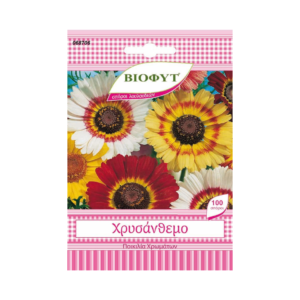
Chrysanthemum
ChrysanthemumChrysanthemum, a perennial plant with abundant flowering and beautiful daisy-like flowers in wonderful colors. Chrysanthemums are among the most popular flowers that bloom in the autumn season and belong to the same family as other favorite flowers such as dimorphotheca, silver marigold, asteraceae, marigold and gerbera. The chrysanthemum is native to Southeast Asia and China.
The seeds are planted in late spring and summer.

Gaillardia
GaillardiaGaillardia is an impressive flower with characteristic green-grey foliage and beautiful flowers that resemble daisies in shades of red, yellow and orange. Gaillardia is characterized by abundant and prolonged flowering that lasts from early summer to mid-autumn. It comes from America and belongs to the same family as the sunflower with several varieties, some annual and others perennial and a height varying between 30-90 cm. Gaillardia is an ideal choice for planting in a flower bed, in a rock garden, as well as in a pot on the balcony. The Gaillardia plant gives a wild flower feel to our garden and is also one of the plants that attract butterflies and birds. Gaillardia needs sunny positions to give us its impressive flowering. It wants light and sandy soil that has good drainage, as young Gaillardia plants are sensitive to excess moisture. To plant it in a pot on the balcony, we prefer places with southern exposure and relatively sheltered, as it is sensitive to low temperatures and strong north winds. In any case, we put a layer of gravel at the base of the pot to drain away the water and not to close the holes of the pot due to soil compression.
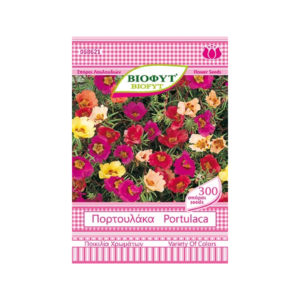
Portulaca
PortulacaPortulaca, also known as silk, is an annual ornamental plant ideal for ground cover in rock gardens, but also for planting in hanging pots on the balcony. Portulaca originates from Brazil and is characterized by creeping vegetation and fleshy oval leaves. The impressive flowering of purslane lasts from spring to autumn, with single or double flowers, monochrome, two-color and even three-color, in shades of yellow, pink, orange, red and white. Portulaca has no particular soil requirements, although it prefers fertile soils with good drainage.

Phlox
PhloxPhlox (with more common species Phlox drummondii and Phlox paniculata, Polemoniaceae) is a popular herbaceous ornamental that grows mainly as an annual, but in areas with mild winters it can be planted as a perennial. It is a genus of at least forty species and many hybrids have been created. Phlox belongs to the Polemoniaceae family, is native to North America and has historically been a fixture in gardens and parks around the world. The phlox Phlox drummondii is a genus of many species, annual and perennial, and belongs to the Polemoniaceae family. It comes from North America and is a plant with great participation in landscape architecture.

Snapdragon Giant
Snapdragon GiantThe Snapdragon, a favorite ornamental plant with wonderful flowers, is planted in the spring and is a characteristic plant of the Mediterranean, with rich vegetation. We will find Snapdragon in dwarf varieties from 20-40 cm, medium height from 40-60 cm and tall varieties from 60-120 cm. Although a perennial plant, it is usually planted as an annual in gardens and in pots on the balcony to give us rich flowering and impressive color combinations. Snapdragon thrive in full sun, although they can adapt and thrive even in shady areas.
