


Achillea

Achillea
The scientific name is Achillea millefolium (as defined by Linnaeus) and the common name is Achillea or millefolium, and it also has other Greek names depending on the region such as agriapsithia, wormwood, Pisidia, Semesando, Milfeig, Similoudi and Lazarus because with the flowers adorn the children who sing about Lazarus in the villages on Holy Saturday. The English name is Yarrow. In Greece there are 24 varieties of Achilles. It belongs to the composite family (Compositae).
Achillea is cold tolerant, prefers well-drained and sunny soils. It is propagated by seeds in the spring (but this only applies to the main species and not to the hybrids) and by root division. It is mainly threatened by fungi in hot and dry conditions. Its flowers, leaves, seeds and essential oil from the flowers and more rarely from the leaves. Its seeds are somewhat bitter and hot and in cooking they are mostly used cooked.
More Products
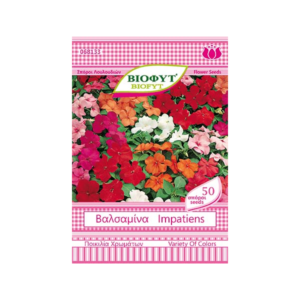
Balsamina
BalsaminaBalsamina is a decorative, small and herbaceous plant of medium growth, with intense foliage and flowers in red and pink shades.
Balsamine (Impatiens balsamine) is also known as balsamine, impatience or love. This plant is preferred for gardens and terraces as it is easy to grow and does not need much care, it has a characteristic multi-month flowering and makes the most of shady places. The planting of the balsamina should be done in shady places and not have direct contact with the sun’s rays. In combination with plenty of water, the balsamina blooms both on the branches and throughout its central trunk.

Four o’clock Flower
Four o’clock FlowerAn ornamental plant even for its leaves. Flowers open on cloudy days. For cultivation, in groups or individually. It is 70 cm tall. It appreciates fresh soil, but be well drained, fertile soils, neutral to alkaline.
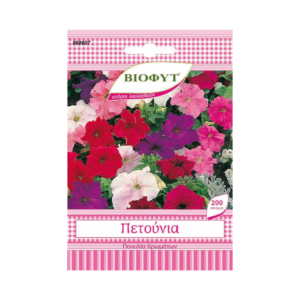
Petunia
PetuniaPetunias have compact, lush vegetation and fast growth, ideal for planting in flower beds and pots without needing too much care. They are particularly popular for their abundant flowering which, with proper care, lasts from early spring to late autumn. Petunia flowers, depending on the variety, can reach a size of 10-15 centimeters and we can choose between dozens of color combinations. There are many different species and varieties of petunias to plant in the garden and in pots. Petunias are divided into three main categories: a) large-flowered varieties of petunias (grandiflora type) with larger flowers, b) multi-flowered varieties (mutliflora type) with more medium-sized flowers and c) thousand-flowered varieties (milleflora type) with numerous small flowers

Primula
PrimulaThe primrose is the first flower to bloom in winter! Although a low-growing herbaceous perennial flower, the primrose is mainly planted as an annual ornamental and gives us its wonderful flowers from early January to late spring. The primula has characteristic lanceolate foliage that grows in the form of a rosette and is an ideal plant to plant in a pot on the balcony, as well as in the garden to create impressive color compositions. The name primrose comes from Latin and means first, confirming its early flowering in the heart of winter. There are, of course, some varieties of primrose that bloom in the autumn months. The leaves of the primrose resemble lettuce leaves, which is why many call it “lettuce”. There are many types of primroses with a wide variety of colors to choose from, from white, red, purple, yellow, pink, orange, blue, as well as striking bi-color varieties that have been created in recent years.

Phlox
PhloxPhlox (with more common species Phlox drummondii and Phlox paniculata, Polemoniaceae) is a popular herbaceous ornamental that grows mainly as an annual, but in areas with mild winters it can be planted as a perennial. It is a genus of at least forty species and many hybrids have been created. Phlox belongs to the Polemoniaceae family, is native to North America and has historically been a fixture in gardens and parks around the world. The phlox Phlox drummondii is a genus of many species, annual and perennial, and belongs to the Polemoniaceae family. It comes from North America and is a plant with great participation in landscape architecture.

Gaillardia
GaillardiaGaillardia is an impressive flower with characteristic green-grey foliage and beautiful flowers that resemble daisies in shades of red, yellow and orange. Gaillardia is characterized by abundant and prolonged flowering that lasts from early summer to mid-autumn. It comes from America and belongs to the same family as the sunflower with several varieties, some annual and others perennial and a height varying between 30-90 cm. Gaillardia is an ideal choice for planting in a flower bed, in a rock garden, as well as in a pot on the balcony. The Gaillardia plant gives a wild flower feel to our garden and is also one of the plants that attract butterflies and birds. Gaillardia needs sunny positions to give us its impressive flowering. It wants light and sandy soil that has good drainage, as young Gaillardia plants are sensitive to excess moisture. To plant it in a pot on the balcony, we prefer places with southern exposure and relatively sheltered, as it is sensitive to low temperatures and strong north winds. In any case, we put a layer of gravel at the base of the pot to drain away the water and not to close the holes of the pot due to soil compression.
