


BIOFYT

Lettuce Red Lola
Lettuce Red LolaLola is a cold season plant that grows best in low temperature conditions. Ideal growth temperature is 14-19°C, while high temperatures cause the early development of the flowering shoot. When planted in autumn, winter and spring we look for a sunny position on the balcony, while in the summer months it is more shaded. Also, we choose a relatively sheltered position from the strong north winds of winter. We must point out that the lola is less tolerant of very low temperatures than the classic lettuces, of the romana variety. cultivation of lettuce can be combined with strawberry, cucumber, onion, garlic, radish and tomato and thus result in very efficient crops. For example, between the lettuces planted every 30 cm, we can plant onion heads or garlic cloves to complement our salad with spring onions and garlic.

Lavender
LavenderLavender is one of the most famous aromatic plants that we plant in pots and is a basic plant found in every garden on a balcony. There are many reasons to plant lavender in a pot, as apart from its beauty it is a plant with multiple uses. Lavender grows best in sunny locations on the balcony and is drought tolerant. We prefer a balcony with south or west exposure so that our lavenders have good growth and flowering. We plant lavender in deep pots with a diameter and height of at least 30 cm, as lavender has a strong root system that goes deep and shows rapid growth.
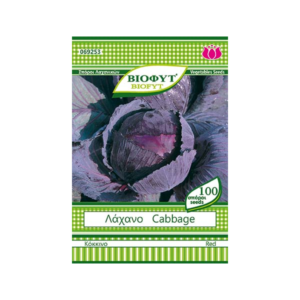
Cabbage Red
Cabbage RedCabbage is a cold season plant and the ideal temperature for its growth is 15-18 degrees Celsius. Cabbages are planted mainly in sunny positions in the fall, although semi-shaded positions are useful in early summer plantings when it is very hot. Cabbage can grow in all types of soil, except very acidic soils. It is important that the soil has good drainage to remove excess water from watering and to ensure good aeration of the roots. For early cabbages we prefer sandy, light warm soils, while for late cabbages we prefer heavier and more fertile soils with good drainage, rich in organic matter.

Brussels sprout
Brussels sproutBefore planting cabbage, the field is cleared of weeds and hard materials such as stones and wood. Cabbage benefits from residues of old crops. So if in the field, there was a previous crop without disease attacks, the residues can, instead of being destroyed, be incorporated into the soil. If it is being installed for the first time, the ground is leveled and plowed or dug to a sufficient depth (30-40cm) to improve aeration and fluff up the soil. 1-2 months before planting the crop, compost or well-digested manure is incorporated into the soil, by milling or carving.

Onion Green
Onion GreenOnions prefer light sandy soil with good drainage to grow better and form a larger bulb. Proper soil preparation is particularly important before starting cultivation. Before planting onions it is important to incorporate organic matter and soil improvement materials such as digested manure and compost into the soil. When planting onion bulbs, we can add complete organic fertilizer to strengthen the crop, especially if our field is cultivated every year and needs nutrients. 4. What season are onions planted and at what distances? The green spring onion can be planted almost all year round in our garden, while if we prefer the dry onion we plant in the March-April period. The planting of the cockle can be done both in lines and in the throws. For the linear planting of onion, shallow furrows are dug at planting distances between the planting lines of around 30 cm. The small onion bulbs are planted at distances between them of about 10 cm for the dry onion and 5-7 cm for the green onion. The planting depth of the onion in the soil should be between 0.5–1 cm, that is, just enough to cover the top pointed part of the bulb. It is worth mentioning that onion can be an excellent side crop and can be grown in our vegetable garden together with tomatoes, cucumbers, strawberries, lettuce, zucchini, beets and carrots.

Zochos (sonchus oleraceus)
Zochos (sonchus oleraceus)The Zochos has a scientific name Sonchus oleraceus. The gorse is in bloom from June to August. Its seeds ripen from July to September. Its flowers are hermaphrodite (has both male and female organs) and are pollinated by bees. The leaves of the plant closely resemble those of grasses of the same family, oblong, smooth, toothed, alternately split into pinnate lobes, and with a broad, succulent petiole that widens at the base to almost embrace the stem, and bears lateral membranous extensions, characteristic of many herbs plants, rather to increase the photosynthetic surface.
