


White Flowers

White Flowers
More Products

Basil Red
Basil RedThere are many types and varieties of basil to choose from. We come across hundreds of varieties of basil, others with smaller or larger leaves, with different colors, tastes and aromas. It is important to mention that most varieties of basil are annuals while there are also some perennials. Depending on our preferences, we can choose curly, broad-leaved, Genovese, nightshade, red (purple), saint or tree basil.
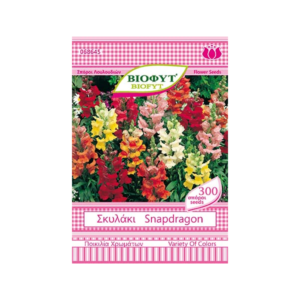
Snapdragon
SnapdragonThe Snapdragon, a favorite ornamental plant with wonderful flowers, is planted in the spring and is a characteristic plant of the Mediterranean, with rich vegetation. We will find Snapdragon in dwarf varieties from 20-40 cm, medium height from 40-60 cm and tall varieties from 60-120 cm. Although a perennial plant, it is usually planted as an annual in gardens and in pots on the balcony to give us rich flowering and impressive color combinations.

Sunflower Bicolor
Sunflower BicolorThe sunflower, the well-known sunflowers, is a favorite summer plant to decorate our garden or balcony to give us its impressive flowering. The name of the sunflower comes from the fact that its head constantly turns towards the sun’s rays during the day and turns again, in the morning hours, towards the east. The dwarf varieties of sunflower, which reach up to 40-50 cm in height, are suitable for pots, while for the garden we prefer the taller varieties that exceed one meter and are also edible. The characteristic color of sunflower flowers is yellow but now new sunflower varieties have been created in shades from pale yellow to red and brown.

Primula
PrimulaThe primrose is the first flower to bloom in winter! Although a low-growing herbaceous perennial flower, the primrose is mainly planted as an annual ornamental and gives us its wonderful flowers from early January to late spring. The primula has characteristic lanceolate foliage that grows in the form of a rosette and is an ideal plant to plant in a pot on the balcony, as well as in the garden to create impressive color compositions. The name primrose comes from Latin and means first, confirming its early flowering in the heart of winter. There are, of course, some varieties of primrose that bloom in the autumn months. The leaves of the primrose resemble lettuce leaves, which is why many call it “lettuce”. There are many types of primroses with a wide variety of colors to choose from, from white, red, purple, yellow, pink, orange, blue, as well as striking bi-color varieties that have been created in recent years.

Sweet Violet
Sweet VioletSweet Violet is a small, decorative plant, originally from Europe. Famous for the intoxicating scent of its purple and white flowers, it blooms late into winter and is surprisingly suitable for small gardens. Resistant to the cold and lively all year round, it can even be used as a ground cover, under rose bushes or ornamental shrubs.

Cactus
CactusCacti need full sun exposure, with very few exceptions, and a long warm season exceeding 6 months to grow. The intense activity of the cacti takes place during the spring and summer period, during which, in addition to growth, they also give their unique flowering. As for winter, a period of dormancy, cacti seek temperatures of 5-15°C, although some of them can withstand sub-zero temperatures for a while. Cacti need coarse, sandy, draining soil to grow. An ordinary general-purpose potting soil is not suitable for cacti, as it retains a lot of moisture. That is why we use specialized potting soil for cacti enriched with nutrients. Cacti definitely need fertilization, especially during the spring and summer when they do most of their growth. Specialized fertilizers for cacti, water-soluble with enough trace elements, are needed to improve growth and give their wonderful flowering. We add water-soluble fertilizer to the cacti twice a month for the spring and summer periods.
