


Forget me not

Forget me not
Forget Me Not is a mountainous perennial plant with blue, odorless flowers, creeping and hairy stems and lanceolate leaves. It is a hardy plant height poa of 10-40 points. In the area of Kastoria it grows next to streams and rivers from March to September. The seeds of the plant should be scattered in rich but well-drained soil in a place with enough sun. They are then mixed with compost in a spot protected from the hot sun during the summer months and at a distance of 3-4 cm between them. Dry soil may adversely affect the seeds. Cultivation can be done in summer so that the flower blooms in winter.
The seeds of the plant should be scattered in rich but well-drained soil in a place with enough sun. Then, they are mixed with fertilizer and placed in polyethylene bags, in a place protected from the hot sun during the summer months and at a distance of 3-4 cm between them. Dry soil may adversely affect the seeds. Cultivation can be done in summer so that the flower blooms in winter.
More Products

Passiflora
PassifloraPassiflora, the flower of passion that impresses with its distinctive shape. Passiflora is a climbing plant that grows very quickly and is a beautiful way to cover fences and pergolas. The impressive flower of the passionflower resembles the shape of a clock, which is why in several regions of our country it is known as a clock. Passiflora is native to South America. It can reach a growth of up to ten meters and gives us its wonderful flowering in the summer. There are hundreds of species of Passiflora, most climbing, although there are also some shrubs and trees among them. A well-known species of Passiflora (Passiflora edulis) is our well-known Passion fruit, whose fruits are eaten.

Amaranth Trichomo
Amaranth TrichomoIn the world flora, common amaranth is represented by more than sixty species. There are annual and perennial crops that are resistant to even the most severe frosts and resistant to any pest. Growing a plant is simple and not troublesome. With such a wide variety of varieties and types, you can get confused and buy feed or vegetables instead of ornamentals. Which varieties are the most popular and in demand and in what quality.

Euphorbia
EuphorbiaEuphorbia lactea cristata, is an easy-to-grow succulent, resulting from the grafting of two species. That is, two plants in one! Its upper part is Euphorbia lactea and its color is silver-grey, which can turn reddish if the plant is happy in its environment. Its lower part is usually Euphorbia neriifolia. Its shape resembles a coral and resulted from a normal mutation of Euphorbia lactea and is also known as Coral plant. Prefer bright spots in the growing area. With gradual acclimatization, it can also live in direct sunlight.

Carnation Pink
Carnation PinkCarnations, one of the classic and much-loved flowers that are traditionally found in the gardens, yards and balconies of Greek homes. The carnation (carnation or dianthus) stands out for its lush vegetation with its characteristic elongated lance-shaped leaves and its rich flowering in impressive colors. There are single color carnation varieties in shades of pink, red, yellow and white, as well as bicolor carnations with wonderful color combinations. This is an extremely popular ornamental plant that, especially in previous decades, was not missing from any home. After all, the carnation has been cultivated since ancient times and was known by the name Dianthos, which means the flower of Zeus. The carnation is planted in the spring and gives us the rich flowering from April to November.
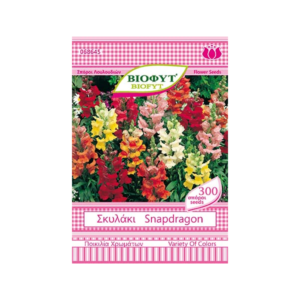
Snapdragon
SnapdragonThe Snapdragon, a favorite ornamental plant with wonderful flowers, is planted in the spring and is a characteristic plant of the Mediterranean, with rich vegetation. We will find Snapdragon in dwarf varieties from 20-40 cm, medium height from 40-60 cm and tall varieties from 60-120 cm. Although a perennial plant, it is usually planted as an annual in gardens and in pots on the balcony to give us rich flowering and impressive color combinations.

Basil Red
Basil RedThere are many types and varieties of basil to choose from. We come across hundreds of varieties of basil, others with smaller or larger leaves, with different colors, tastes and aromas. It is important to mention that most varieties of basil are annuals while there are also some perennials. Depending on our preferences, we can choose curly, broad-leaved, Genovese, nightshade, red (purple), saint or tree basil.
