


Lavender

Lavender
Lavender is one of the most famous aromatic plants that we plant in pots and is a basic plant found in every garden on a balcony. There are many reasons to plant lavender in a pot, as apart from its beauty it is a plant with multiple uses. Lavender grows best in sunny locations on the balcony and is drought tolerant. We prefer a balcony with south or west exposure so that our lavenders have good growth and flowering. We plant lavender in deep pots with a diameter and height of at least 30 cm, as lavender has a strong root system that goes deep and shows rapid growth.
Lavender has low water requirements, while overwatering can cause root rot, especially if water is not properly drained from the pot. We water the potted lavender every 5 days, during the spring and autumn, and every 3 days during the summer. In terms of fertilization, we incorporate 2 tablespoons of complete compost every month from early spring to late fall to promote growth and flowering.
More Products
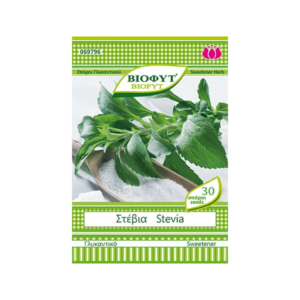
Stevia
SteviaStevia is a perennial plant, also known as melophyllo or sweet leaf of Paraguay. Stevia contains a substance, steviol, which has a high sweetening power, which is why it is used as a sweetener instead of sugar. We can grow stevia in a pot or in the garden and harvest its leaves to sweeten our coffee, tea or to use in various homemade sweets.

Rocket Salad
Rocket SaladRocket Salad, one of the most aromatic and spicy herbs in the garden, with the unique taste that we enjoy in green salads and in cold sandwiches together with lettuce, spinach and Italian parmesan! In recent years, arugula has been particularly popular and is planted in many gardens during autumn and winter, as its cultivation presents no difficulties. And if we don’t have a garden, it doesn’t matter! Growing arugula in a pot is so easy that it’s an ideal starter for novice gardeners, as well as young children taking their first steps into gardening. There are many varieties of arugula to choose from, with more aromatic or spicier flavors. We will also find broad-leaved varieties of arugula with lush vegetation, as well as varieties with a special red-green foliage.

Fennel
FennelFennel belongs to the apiaceae family. The root is white and penetrates to a great depth and the shoot is upright, green and cylindrical. The main part of the plant is its lower part, which is the pseudobulb of the fennel and is basically a thickening of the leaves at their base. The flowers are small and the fruits are 5 mm in diameter, oblong with shades of green and light grey-brown.

Marconi beans
Marconi beansThere are many popular native and traditional bean cultivars, both low and climbing, to choose from. Most growers prefer fresh bean varieties that do not have fiber, as they are more pleasant to eat. We should note that the dry bean varieties have a harder shell and more fiber. Well-known varieties of fresh beans are chauli, terli, broad bean (black-eyed), broad bean (snake bean), mullets (beads), canary beans (yellow beans), bulgara (early mullet), zargana, climbing mullet, while in some regions we will meet other interesting local varieties. An excellent traditional variety of dry beans are the giants of Prespa. It is worth noting that the climbing bean varieties are much more productive than the low varieties, while at the same time they have a longer production period, although they take longer to enter production than the low ones.
Bean cultivation needs fertile soil, rich in organic matter and with good drainage to have good growth and fruiting. When preparing the soil for cultivation, we first plow the field to make the soil sufficiently loose, as it is necessary for the formation of a rich and strong root system of the bean. Then, before planting the bean, we incorporate enough compost, digested manure and organic manure to enrich the soil with organic matter and nutrients.

Carrot
CarrotCarrot, one of the most delicious and nutritious vegetables that we plant in the spring and autumn season. Famous for the sweet, crunchy and aromatic taste of its fleshy root, the carrot is a favorite food for young and old. It grows in the ground with its leaves protruding above the soil, as is the case with beetroot, radish, onion and garlic. The carrot is eaten fresh in winter salads along with cabbage and lettuce, but also cooked in various recipes, such as in the traditional bean salad. We can also make carrot cake, thanks to its sweet taste. Carrots need relatively cool conditions to grow and perform well, as well as plenty of sunlight. Ideal temperature conditions for carrot cultivation are between 16-18°C. Carrot cultivation is relatively resistant to winter frost, while at high temperatures that exceed 25°C the growth of the carrot root stops, it becomes woody and its color fades.

Celery aromatic
Celery aromaticCelery varieties, depending on the part of the plant for which they are grown, are divided into two main categories: a) leafy ones that have rich foliage vegetation and b) rhizomes that have less growth of the above-ground part of the plant and more root growth. The best-known varieties are the traditional variety of celery, the variety of celery and the variety of celeriac, which have the following characteristics: Common variety of celery: Traditional local leafy variety of celery with thin stems and leaves that have a strong aroma and taste Celery variety: Classic leafy variety of celery with thick crisp stems that reach a height of up to one meter and large leaves but not as strongly scented as the common variety. Celery root variety: Characteristic variety of root celery eaten for its large round root, fresh or cooked in salads and soups.
