


Carnation Chinese

Carnation Chinese
Carnations grow best in bright and sunny places, where they give us many flowers. It is not afraid of winter and is a cold-resistant plant, as it can withstand sub-zero temperatures. On the contrary, the very hot and dry summers bother her. Temperatures above 35 degrees can weaken the plant and dry it out. The carnation prefers rich, fertile soil with good water drainage, as it is sensitive to excessive moisture and its roots can rot. Depending on the type of carnation, we choose the appropriate type of pot and planter. For tall varieties of carnation, we need pots with a height of at least 30 cm. For the lowest varieties, pots with a depth of 20 cm are sufficient.
Carnations have moderate watering needs. During the spring and autumn, we water the carnation twice a week, while in the winter the watering becomes more sparse. During the summer months and in hot conditions, especially when in small pots, the carnation needs more frequent watering, at least every two days, to cope with the very high temperature levels. Because carnations are sensitive to soil moisture, water only after checking that the soil is dry.
More Products

Snapdragon Giant
Snapdragon GiantThe Snapdragon, a favorite ornamental plant with wonderful flowers, is planted in the spring and is a characteristic plant of the Mediterranean, with rich vegetation. We will find Snapdragon in dwarf varieties from 20-40 cm, medium height from 40-60 cm and tall varieties from 60-120 cm. Although a perennial plant, it is usually planted as an annual in gardens and in pots on the balcony to give us rich flowering and impressive color combinations. Snapdragon thrive in full sun, although they can adapt and thrive even in shady areas.

Zinnia Giant
Zinnia GiantZinnia is an annual ornamental plant that impresses with the variety of colors and shapes of its flowers. The zinnia has upright strong shoots with a length of half to one meter and large flowers that remain in bloom throughout the summer. We can find tall and short varieties of zinnia and plant them in a pot but also in a rock garden, on the lawn, and in flower beds, in various combinations with other herbaceous flowering plants.
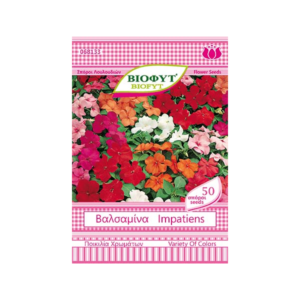
Balsamina
BalsaminaBalsamina is a decorative, small and herbaceous plant of medium growth, with intense foliage and flowers in red and pink shades.
Balsamine (Impatiens balsamine) is also known as balsamine, impatience or love. This plant is preferred for gardens and terraces as it is easy to grow and does not need much care, it has a characteristic multi-month flowering and makes the most of shady places. The planting of the balsamina should be done in shady places and not have direct contact with the sun’s rays. In combination with plenty of water, the balsamina blooms both on the branches and throughout its central trunk.


Four o’clock Flower
Four o’clock FlowerAn ornamental plant even for its leaves. Flowers open on cloudy days. For cultivation, in groups or individually. It is 70 cm tall. It appreciates fresh soil, but be well drained, fertile soils, neutral to alkaline.

Phlox
PhloxPhlox (with more common species Phlox drummondii and Phlox paniculata, Polemoniaceae) is a popular herbaceous ornamental that grows mainly as an annual, but in areas with mild winters it can be planted as a perennial. It is a genus of at least forty species and many hybrids have been created. Phlox belongs to the Polemoniaceae family, is native to North America and has historically been a fixture in gardens and parks around the world. The phlox Phlox drummondii is a genus of many species, annual and perennial, and belongs to the Polemoniaceae family. It comes from North America and is a plant with great participation in landscape architecture.
